When selecting PA speakers, many people initially focus on wattage. However, speaker wattage alone doesn’t tell you how loud a speaker will be. The key metric to consider is Sound Pressure Level (SPL).
Understanding SPL
“Sound pressure level (SPL) or acoustic pressure level is a logarithmic measure of the effective pressure of a sound relative to a reference value.” – Wikipedia
What matters to us here is the fact that SPL is a measure that correlates to the real-life loudness of the speaker. How accurately and on what principle it is measured by the manufacturer is another topic by itself but nonetheless most brands state the max SPL of the speaker at the specification of their product and that is the value you should compare when choosing a PA speaker. Usually, it is stated with the accuracy of +-3db or +-10db, measured at 1m distance. If the manufacturer also has a response graph, even better, then we can see the actual characteristics of the speaker, like how much low end it will produce for example.
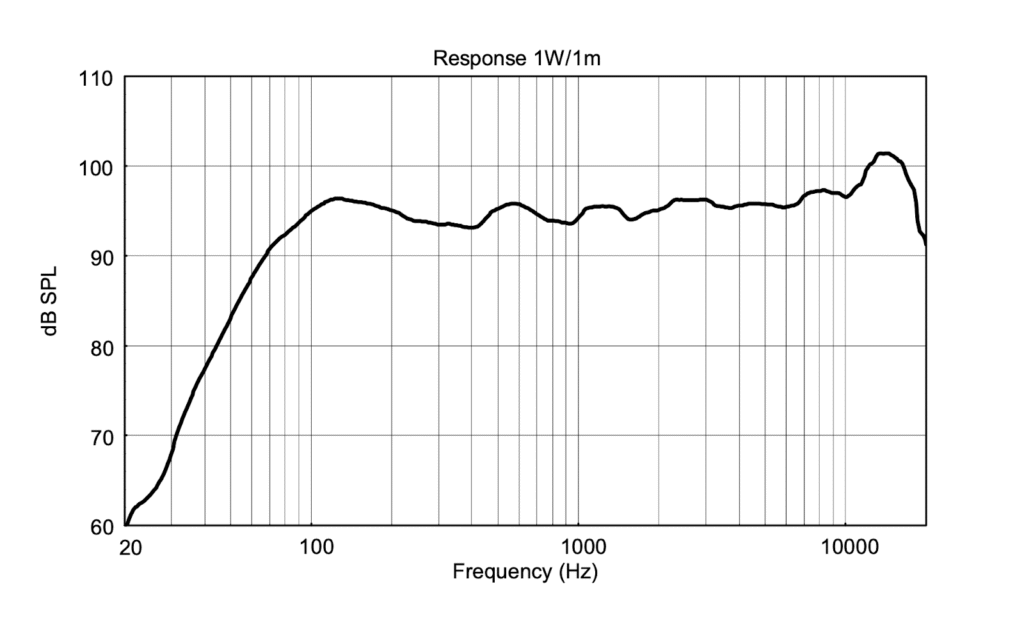
The above graph is a speaker response that is measured at 1m distance with the input of 1W power. We can see that the low end is boosted and expect it to go down as low as 70Hz while maintaining an SPL level of 90dB. But you must always remember to check how the values are measured. The spec also states that the speaker has a maximum SPL value of 129dB measured at 1m distance and that is the actual value to compare with the other speakers as most manufacturers state the maximum SPL level for their speakers.
SPL is a measure that correlates to the real-life loudness of the speaker.
Speaker Efficiency and Wattage
Here is where the wattage of the speaker comes into play. When choosing an active speaker that has the amplifier built-in then we do not need to worry ourselves with the efficiency of the speaker and the wattage, the manufacturer has already chosen the optimal amplifier and speaker combination to get the most out of them.
It is especially important however to know about this when you need to combine a speaker with an amplifier yourself like with a passive PA set. A simple rule here is to get an amplifier that is 2 times the power of the speaker’s RMS value at the correct resistance (Ohm) to get the most out of your speaker. If you have a specific SPL level that you need to achieve and have a speaker that can produce much more, then getting a double powered amplifier is not very efficient cost-wise. Here you should check what is the speaker efficiency in dB that is measured with input power of 1 watt measured at 1 meter distance (1W/1m). With every doubling of the input power, we get an additional 3dB of SPL and with every doubling of the distance from the speaker we lose 6dB. This is not entirely a linear equation, especially near the speaker, but it is linear enough to make calculations that will give you acceptable results. What SPL level is required for any given situation is determined by the type of event and background/crowd noise level over which the program material needs to be heard.

Sound pressure level, denoted Lp and measured in dB
Conclusion
Don’t be misled by large wattage numbers in advertisements. While they can offer a rough indication of whether a speaker is for home use or stage performance, they don’t tell the whole story. Dig into the specifications and look for SPL values and frequency response graphs for a more accurate understanding of a speaker’s capabilities. Remember that loudness is just one aspect of speaker performance, and manufacturers often push numbers to their limits. Ultimately, your ears are the best judge of what sounds good for your specific needs.